



































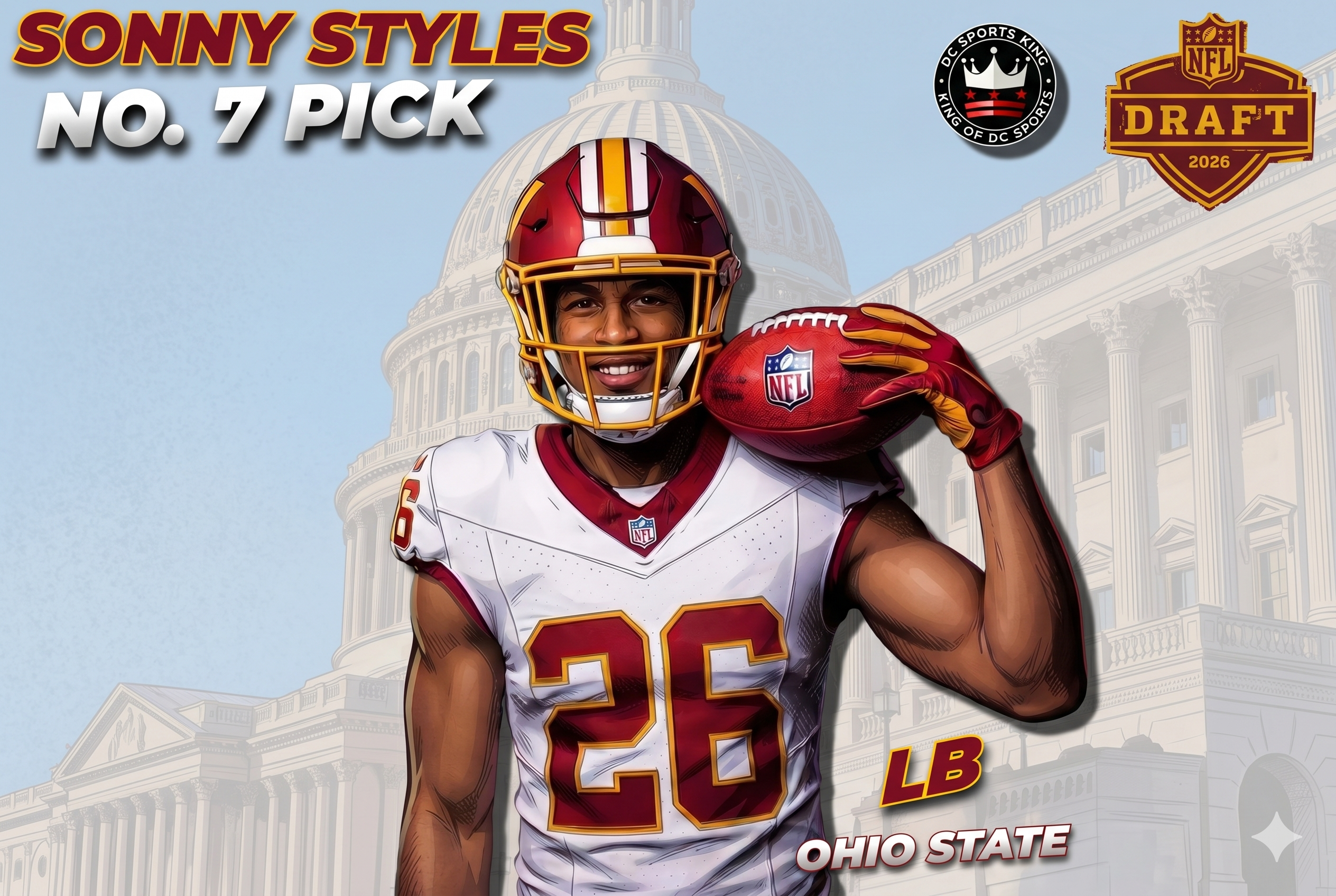
Draft Grade: A
The Washington Commanders have officially made their move in the first round of the 2026 NFL Draft, securing a foundational piece for their defense. By selecting Ohio State linebacker Sonny Styles with the No. 7 overall pick, the Commanders have addressed their most glaring defensive need with one of the most athletically gifted prospects in recent draft history. After a period of intense speculation regarding potential trade-backs or offensive investments, Washington remained steadfast, identifying a prospect capable of reshaping the identity of the entire defensive unit.
This selection earns an immediate “A” grade. The front office did not overthink the process. They identified a blue-chip talent who not only fits the precise athletic profile required in the modern NFL but also seamlessly aligns with the strategic pivot the franchise is undertaking defensively. Styles represents a rare intersection of a high-floor producer and an exceptionally high-ceiling athlete. In a league where offenses constantly attempt to dictate matchups through pre-snap motion and positionless skill players, drafting a versatile defensive chess piece like Styles is a profound victory for the organization.
The Ohio State Pedigree and Unmatched Athleticism
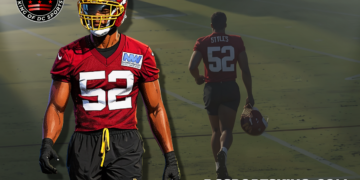
To understand why the Commanders invested a top-10 pick in Styles, one must first look at the sheer physical dominance he exhibited during his collegiate career. At 6-foot-5 and 244 pounds, Styles possesses the frame of a traditional edge rusher combined with the kinetic fluidity of a defensive back. This unique physical makeup translated into elite production in Columbus. Over his final two seasons at Ohio State, Styles was the undisputed anchor of one of the most fearsome defenses in college football, racking up 183 tackles and earning First-Team All-American and All-Big Ten honors in 2025. He finished his collegiate tenure with 244 total tackles and 22.5 tackles for loss, consistently proving his ability to disrupt plays behind the line of scrimmage.
However, the raw production only tells half the story. The pre-draft evaluation process solidified Styles as an unprecedented athletic specimen. At the NFL Scouting Combine in Indianapolis, Styles delivered a historically dominant performance, firmly locking him into the top half of the first round. Clocking a 4.46-second 40-yard dash at 244 pounds is extraordinary, but pairing that straight-line speed with a 43.5-inch vertical jump and an 11-foot-2 broad jump cemented his status as a generational athlete. These testing numbers culminated in a near-perfect Relative Athletic Score (RAS) of 9.99, ranking fourth among all linebackers evaluated since 1987. For the defense, these metrics confirm that Styles has the closing speed to chase down elite running backs and the vertical leaping ability to disrupt passing lanes over the middle of the field.
The Safety Background: A Quarterback of the Defense
What makes Styles particularly intriguing—and arguably the most compelling aspect of this draft pick—is his unconventional developmental path. Although he is entering the NFL as a highly touted linebacker, his football foundation was built in the secondary. Styles originally arrived at Ohio State as a top-ranked safety prospect out of Pickerington Central High School, where he showcased natural instincts in coverage, recording multiple interceptions and pass breakups. He spent his first two collegiate seasons playing free safety, strong safety, and nickelback before making the full-time transition to the second level of the defense in 2024.
This safety background is not merely trivia; it is the core reason Styles is uniquely prepared for the rigors of the NFL. Transitioning from the secondary to the box provides a defender with a macro-level understanding of route concepts, spacing, and coverage shells. As Styles noted during the pre-draft process, playing safety allowed him to understand the totality of a defensive scheme, enabling him to see the entire picture before moving closer to the line of scrimmage.
For the Commanders, this high football IQ translates into a linebacker who does not have to be subbed out in obvious passing situations. In the modern game, linebackers are routinely targeted and isolated in coverage by athletic tight ends and pass-catching running backs. Styles brings the fluid hips, precise footwork, and spatial awareness of a defensive back to the linebacker position. He can seamlessly drop into deep zone coverage, carry tight ends down the seam, or match up man-to-man against dynamic running backs out of the backfield. The transition from reading the quarterback’s eyes deep in the secondary to dissecting run fits in the box has refined his processing speed, enabling him to diagnose plays rapidly and react without hesitation.
A Perfect Fit for the New Defensive Scheme
Sonny Styles’ arrival in Ashburn coincides perfectly with the defensive overhaul currently being orchestrated by the coaching staff. Following the departure of Joe Whitt Jr., the Commanders are installing a brand-new defensive system under incoming defensive coordinator Daronte Jones. The absolute hallmark of Jones’ defensive philosophy is multiplicity—utilizing multiple fronts, ranging from traditional 4-3 alignments to heavy 3-4 looks, while maintaining a consistent seven-man spacing concept.
In a scheme predicated on the idea that “it is not how they line up, it is how they wind up,” positional versatility is the most valuable currency a defender can possess. Styles is the ideal prototype to serve as the linchpin of this multi-system. Because he is exceptionally comfortable playing in space and possesses the sheer size and length to pop off blocks from offensive linemen, the coaching staff will have the luxury of deploying him in countless alignments. He can play as a traditional Mike linebacker, shift to the outside to set the edge on early downs, or roll down to function as a specialized dime backer in sub-packages.
Furthermore, a defense aiming to disguise its intentions pre-snap heavily relies on players who can execute multiple assignments flawlessly. When an opposing quarterback looks across the line of scrimmage and sees Styles, it will be nearly impossible to determine whether he is blitzing the A-gap, dropping into a deep zone, or covering a primary target man-to-man. This unpredictability creates structural hesitation, which in turn forces offensive mistakes. By serving as the communication hub of this new-look defense, Styles will force opposing play-callers to constantly account for his whereabouts.
The Long-Term Outlook for Washington
The acquisition of Sonny Styles signals a distinct turning point for the Washington Commanders. The defensive unit desperately required an infusion of youth, elite speed, and dynamic playmaking ability in the middle of the field. The front office correctly identified a glaring structural weakness and aggressively targeted the absolute best available solution on the draft board.
Styles is far from a high-upside developmental project; he is a plug-and-play starter who has been forged in the high-pressure, physical environment of the Big Ten. Having competed for national championships and served as a highly respected team captain for the Buckeyes, he brings an established leadership pedigree and an uncompromising winning mentality to a locker room eager to build a dominant physical culture.
While there is inevitably an adjustment period for any rookie acclimating to the speed and complexity of the professional game, the developmental foundation here is exceptionally solid. The rare combination of his elite physical traits, his invaluable collegiate experience operating as a safety, and his flawless schematic alignment with the new defensive philosophy paints a vivid picture of a player destined for immense professional success. The Commanders needed a cornerstone to build the future of their defense around, and with the seventh overall pick, they found exactly that in Sonny Styles.