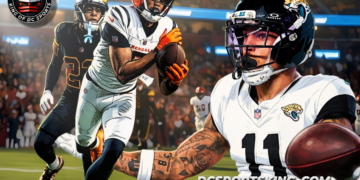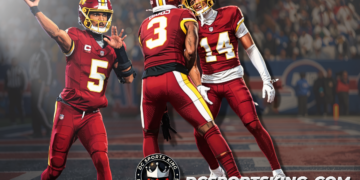
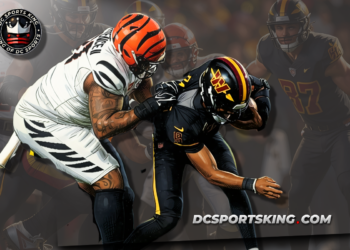





























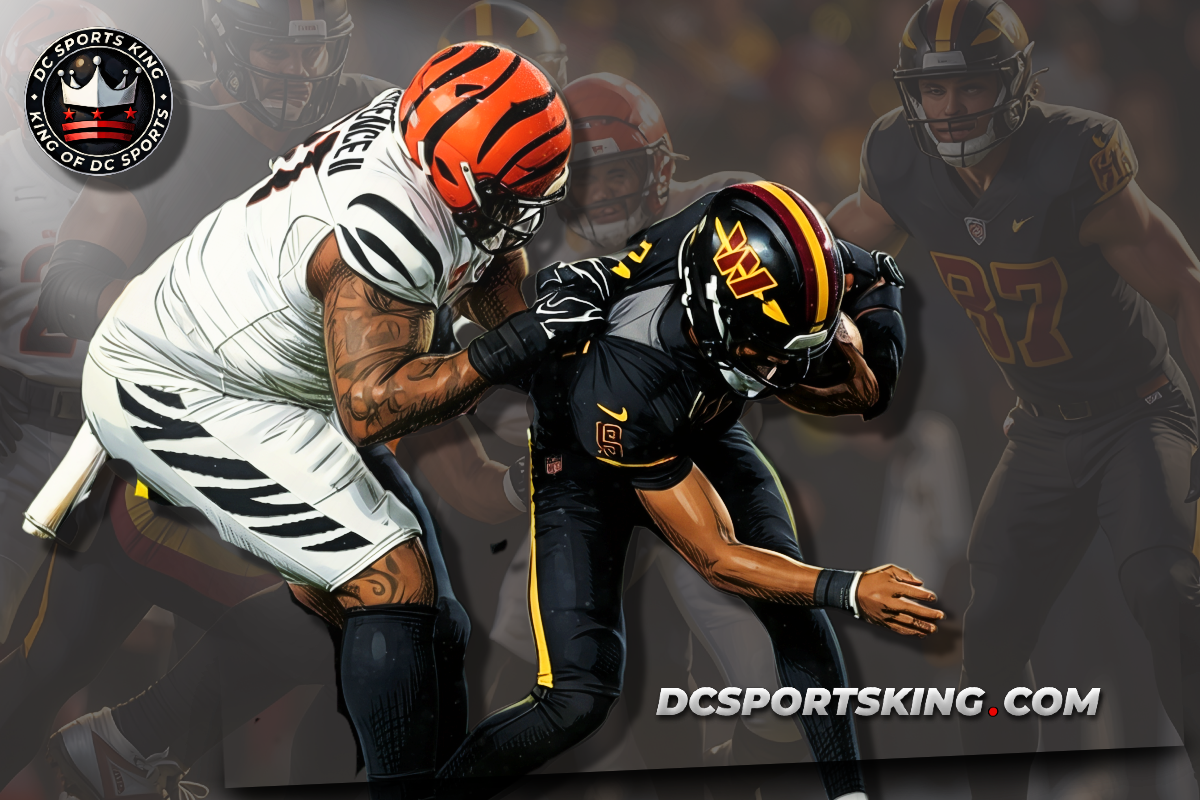
When Cincinnati Bengals defensive tackle Dexter Lawrence dragged Washington Commanders quarterback Jayden Daniels down for an early sack during Monday Night Football at Northwest Stadium, the reaction from the Burgundy and Gold faithful was immediate. Fans in the stands and across social media immediately clamored for a yellow flag, convinced that Lawrence had committed a textbook horse-collar tackle. Yet the officials kept their flags tucked away, the sack stood, and Washington was left staring at a long-yardage situation. While the no-call looked jarring in real time — especially given lingering concern about Daniels’ health entering Week 11 — the officiating crew got this one completely right under the letter of the 2026 NFL Rulebook.
Understanding why Dexter Lawrence avoided a 15-yard personal foul requires looking past the optics of a 340-pound interior lineman hauling down a franchise quarterback by the upper jersey and focusing on one of professional football’s most misunderstood carve-outs.
Breaking Down the Exact Rule: NFL Rule 12, Section 2, Article 16
On the surface, the outrage from Commanders fans makes plenty of sense. Under Rule 12, Section 2, Article 16 of the 2026 NFL Rulebook, a defender is prohibited from grabbing the inside collar of the back or side of a runner’s shoulder pads or jersey, or grabbing the jersey at the nameplate or above, and pulling the runner toward the ground. The ball carrier does not even have to hit the turf for the penalty to trigger; if the pulling motion buckles the runner’s knees, it is an automatic 15-yard penalty and a first down.
However, the very next sentence of that rule is the exact clause that bailed Lawrence out on Monday night. The NFL explicitly states that the horse-collar restriction does not apply to a runner in the tackle box or a quarterback in the pocket.
Because Lawrence—who has been terrorizing interior offensive lines since Cincinnati acquired him in a spring trade—collapsed the pocket quickly and got his hands on Daniels before the quarterback ever escaped the tackle-to-tackle pocket area, the horse-collar protection was never active on the play. Even if Lawrence’s grip landed squarely on the nameplate or inside the back of Daniels’ shoulder pads, the officials had no rulebook basis to throw a flag.
Why the NFL Still Allows Horse-Collar Tackles in the Pocket
Every time a quarterback gets yanked down from behind in the pocket, the same debate resurfaces: if the NFL is serious about protecting quarterbacks, why does this loophole still exist?
The answer comes down to biomechanics and the rule’s original intent. The league outlawed the horse-collar tackle back in 2005 after a string of gruesome lower-leg and knee injuries—most famously involving defenders chasing down ball carriers at full speed in the open field. When a receiver or running back is sprinting at 20 miles per hour and gets yanked straight backward by the collar, their momentum traps their legs underneath the tackler’s falling body weight, creating devastating torque on the knees and ankles.
Inside the pocket, the physics are completely different. A quarterback dropping back to pass or stepping up to avoid an interior rush is either stationary or just beginning to accelerate. Being pulled down from behind at low speed generally results in the passer sitting down or falling backward without the violent, high-velocity leg-trapping motion seen in open space.
There is also a practical officiating reality at play. Pass rushers battling 300-pound offensive linemen in tight quarters often only get one arm free to disrupt a mobile quarterback like Daniels. If defensive linemen were penalized for grabbing the upper jersey or shoulder pads while fighting through blocks inside the tackle box, sacking an elusive passer would become nearly impossible.
The College Football Factor Adding to Fan Confusion
Another reason this no-call sparked so much confusion on social media is that the rules in college football and the NFL no longer match on this specific point.
Fans who watch a heavy diet of Saturday football are used to seeing flags fly for horse-collar tackles near the line of scrimmage because the NCAA updated its rulebook to apply horse-collar penalties inside the tackle box. The NFL has not followed suit. In the pros, the tackle box and pocket remain a protected zone for defenders making upper-jersey tackles.
Furthermore, while the 2026 NFL rules allow limited replay assistance on horse-collar plays, that mechanism works only one way: replay officials can step in to pick up a called flag if clear video shows the defender’s hand never touched the collar or nameplate. Replay cannot be used to flag a legal sack inside the pocket retroactively.
What Protections Still Apply to Jayden Daniels in the Pocket
Just because the pocket exception removes the horse-collar penalty does not mean defenders have a free pass to do whatever they want to a quarterback. Even inside the tackle box, officials are still strictly enforcing several other player-safety rules:
- Facemask fouls: Any grasping and twisting of the quarterback’s facemask or helmet opening remains an automatic 15-yard penalty regardless of location.
- Roughing the passer: Defenders still cannot drive the quarterback into the ground with their full body weight, strike the head or neck area, or hit the passer forcibly at or below the knee.
- Transition out of the pocket: The exact moment Daniels breaks containment and steps outside the tackle box—turning himself into a runner in space—the horse-collar protection immediately turns back on.
The Bigger Picture for Washington’s Offensive Line
Ultimately, the early sack reminded everyone how thin the margin for error is against an All-Pro-caliber disruptor like Dexter Lawrence—even for a Washington interior line featuring center Lucas Patrick, who cleared concussion protocol just in time for Monday night. You cannot rely on officiating bailouts when a pocket collapses that quickly.
Fortunately for Washington, Daniels proved once again why he is built for prime-time moments. He finished the night with 289 passing yards, 55 rushing yards, and zero turnovers, delivering two clutch strikes to rookie Antonio Williams down the stretch to stun the 7-2 Bengals. The non-call on Lawrence made for a frustrating early talking point, but by the time the clock ran down to zero in Landover, it was just a footnote in one of Washington’s gutsiest wins of the 2026 season.