






































- Finding His Swing: Crews responded well to the demotion, posting a .258 average in Rochester and demonstrating much better command of the strike zone.
- Service Time Implications: The timing of this call-up is not a coincidence. Crews needed 137 days on the big league roster this year to cross the two-year service time threshold. Because there are only 132 days remaining in the 2026 season, he will fall just short. This pushes his ultimate path to free agency back to the 2031-2032 offseason.
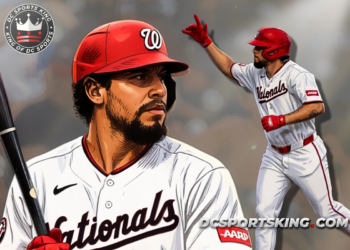
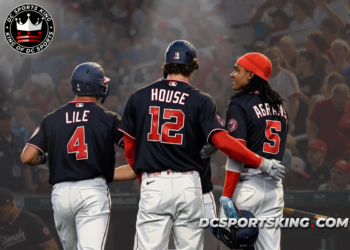
In a move that radically changes the immediate complexion of their lineup, the Washington Nationals have optioned third baseman Brady House to Triple-A Rochester and recalled highly regarded outfielder Dylan Crews.
While House and Crews represent the cornerstone of Washington’s drafting strategy over the past few years, their development timelines have suddenly diverged. Here is a breakdown of why the front office pulled the trigger and what it means for the roster moving forward.
Why Brady House Needed Rochester
Sending down a player who has started 38 of the team’s first 48 games is a surprise on the surface, especially when House has flashed legitimate power. His seven home runs tie him for third on the team. However, a deeper dive into the analytics reveals why a stint in Rochester is the right move for the 22-year-old.
- The Strikeout Issue: House has been plagued by a 28% strikeout rate and a modest 7.3% walk rate. While he consistently hits the ball hard (43% hard-hit rate), his contact rate ranks in the bottom 15 among all qualified MLB hitters.
- Platoon Splits: House has mashed left-handed pitching to the tune of a .354 average and .563 slugging percentage. However, right-handers have completely baffled him; he is hitting just .174 with 37 strikeouts in 115 at-bats against righties.
- Defensive Struggles: The hot corner has been a liability. House ranks second in the majors among third basemen with eight errors, and advanced metrics (Defensive Runs Saved and Outs Above Average) place him in the bottom five at his position.
Brady House has not faced Triple-A pitching since making the leap to the majors last June. Getting everyday at-bats in Rochester without the pressure of a major league pennant chase is designed to help him refine his plate discipline and iron out his throwing mechanics.
The Return of Dylan Crews
When the Nationals demoted the former #2 overall pick at the end of Spring Training following a dismal 3-for-34 showing, it raised eyebrows. However, the stint in Triple-A appears to have served its purpose.
After a sluggish start to the season, Dylan Crews caught absolute fire in May, giving the Nationals front office no choice but to bring the 2023 No. 2 overall pick back to the big leagues. Sent down to Triple-A Rochester during spring training to refine his approach and optimize his ball flight, Crews answered the bell.
The May Awakening
Across 41 total games with the Red Wings, Crews slashed a respectable .258/.345/.432 with 5 home runs, 20 RBIs, and 7 stolen bases. But it was his late-spring surge that punched his ticket back to D.C.:
- The Hot Streak: Over a pivotal 14-game stretch, he posted a .291/.339/.527 line with seven doubles.
- Player of the Week: In his final six games before the call-up, he scorched opposing pitchers, going 9-for-22 (.409) with two homers, five RBIs, and a staggering 1.276 OPS.
- Plate Patience: He bumped his walk percentage to a career-high 10.9%.
The Underlying Metrics
The advanced stats paint a picture of a prospect making elite contact, though still battling discipline issues:
- Crushing the Baseball: When Crews connects, he does damage. His hard-hit rate hovered between 46.8% and 50%—the highest of his pro career—paired with an average exit velocity of 94 mph.
- The Strikeout Concern: The swing-and-miss tendencies haven’t vanished entirely. His strikeout rate sits at roughly 26.2%, fueled by a chase rate exceeding 31%. Major league arms will absolutely test his discipline outside the zone until he proves he can lay off the breaking stuff.
The Ripple Effect on the Lineup
Bringing Crews back into the fold creates a domino effect across the diamond, particularly given the sudden injury to center fielder Jacob Young.
- The Outfield Rotation: With Young day-to-day after taking a 93 mph fastball to the ribs against the Mets, Crews has an immediate, everyday path to playing time. Even when Young returns, Crews is expected to rotate through the outfield corners and designated hitter, keeping James Wood and Daylen Lile’s bats in the lineup.
- Patching Third Base: Washington’s infield defense takes a hit, but the team will lean on a platoon of Jorbit Vivas and José Tena to cover third base in House’s absence. Curtis Mead could also see some action at the corner, though the team prefers his glove at first base.
The Nationals are making a calculated bet: they are sacrificing some of House’s raw power to improve their outfield depth and give Crews a chance to prove his disastrous spring was a fluke, not a trend.