




























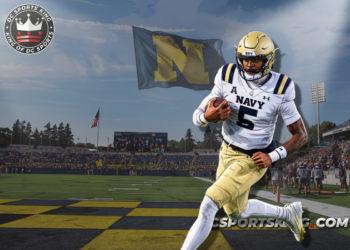



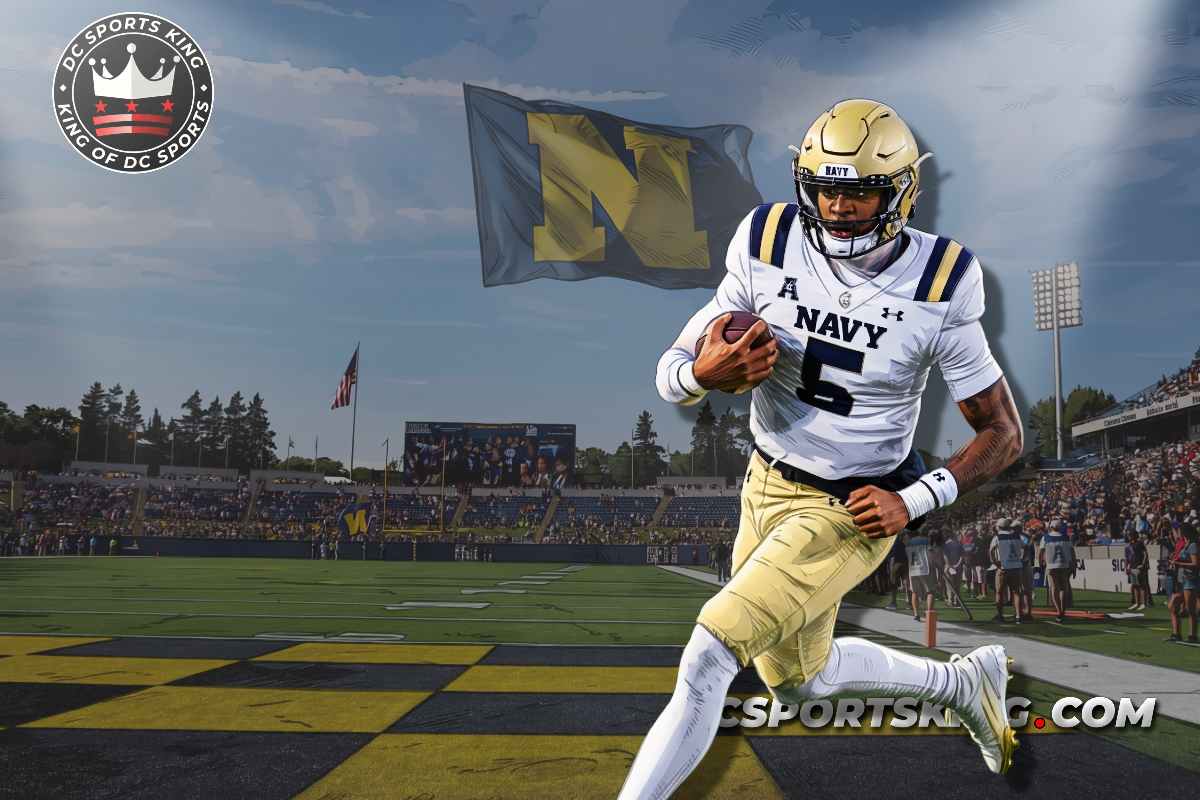
If there was any lingering doubt about who would command the huddle for Navy football in 2026, Braxton Woodson erased it under the stadium lights last season. After starting multiple games and steadily gaining confidence, his heroic fourth-quarter performance against South Florida was the definitive arrival moment. Now, the keys to the offense belong entirely to him.
Taking over as the undisputed full-time QB1, Woodson isn’t just bringing athleticism to Annapolis. He’s fundamentally changing how defenses have to prepare for the Midshipmen.
Altering the Geometry of the Gridiron
In a triple-option-influenced system, the core objective is to leverage numbers and create angles. Woodson’s elite, sprinter-level speed fundamentally warps those traditional defensive angles. Having already racked up over 500 rushing yards and nine touchdowns on the ground in a rotational role over the past two seasons, his acceleration to the perimeter is a known commodity.
Edge defenders who typically play “half-a-man” to string out a quarterback run suddenly find their margin for error gone.
The Horizontal Stretch: Defenses are forced to scrape their linebackers completely out of the box to respect the edge speed.
Wider Interior Lanes: As defenses stretch horizontally, the B and C gaps naturally widen, creating softer inside running lanes for the fullbacks.
This pure speed dictates that linebackers must play sideline-to-sideline rather than downhill, creating the subtle hesitation that fuels a successful option attack.
The Push for Down-to-Down Consistency
Highlight-reel runs like his 64-yard breakaway against USF prove a high ceiling, but navigating a grueling American Conference schedule requires more than raw athleticism. For the 2026 campaign, the focus shifts to down-to-down consistency.
Success relies on making the correct read on second-and-short, understanding when to pitch the ball, and avoiding negative plays that kill drive momentum. Championship-level quarterbacking in this system is built on rhythmic, methodical execution rather than relying solely on athletic bailouts.
Trench Stability: A Quarterback’s Best Friend
The single biggest factor working in Woodson’s favor this year isn’t his 40-yard dash time—it’s the massive wall of experience in front of him. A first-year full-time starter needs predictability, and Navy has it in spades with four returning veteran starters on the offensive line.
Anchored by the dominant presences of Hoke Smith II and Cam Nichols, this unit supplies crucial trench stability.
Pre-Snap Communication: Veterans like Smith and Nichols can identify complex blitz packages, taking the cognitive load off Woodson so he can focus on his option reads.
Sustained Blocks: When Woodson decides to pull the ball and bounce outside, he can trust that the edge seal will actually hold.
The Ultimate Counter-Punch: Cronic to Hutchison
As Woodson proved his legs are lethal, American Conference defensive coordinators will inevitably adjust by creeping safeties up and stacking the box to stop the run. This is where offensive coordinator Drew Cronic will deploy his most potent counterpunch: deep-three receiver Luke Hutchinson.
Cronic’s philosophy excels at merging the traditional option with Wing-T misdirection to keep defenses off balance. As players within the program have noted, Cronic never calls plays randomly; his ability to cause confusion and set up defenses is unparalleled.
When a safety bites on run action, Cronic’s play-action passing tree will aggressively target Hutchison on vertical routes and deep crossers. Hutchison proved just how lethal he can be last season, averaging a staggering 26.8 yards per reception while turning limited targets into three touchdowns. If defenses commit their entire secondary to stopping Woodson on the ground, Hutchison possesses the raw speed to punish them down the sideline, creating a pick-your-poison scenario that will test every defense on the schedule.