



































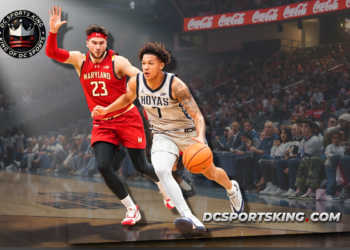








The script was practically writing itself. No. 12 Arkansas arrived at Capital One Arena in the nation’s capital for an early-season marquee showcase against No. 9 Virginia, bringing one of the nation’s most electric talents, super freshman and Paul VI Catholic standout Jordan Smith Jr. For the five-star guard, it was meant to be a triumphant return to the DMV—a chance to put on a show in front of a hometown crowd that watched him dominate the Washington Catholic Athletic Conference (WCAC).
Virginia had other plans.
In a clinic of disciplined, suffocating basketball, the Cavaliers dismantled Arkansas 91-72, neutralizing the Razorbacks’ transition game and spoiling Smith’s highly anticipated homecoming. If anyone needed a reminder that high-octane hype eventually has to execute against elite half-court execution, Virginia provided it.
Here is a comprehensive breakdown of how Virginia dominated the matchup and dictated the terms of engagement from the opening tip.
The Pack Line Defense
Coming into the contest, the narrative was centered entirely on Arkansas’ athleticism and Smith’s explosive ability to attack the rim and create in space. Virginia’s counter was beautifully simple in theory, yet incredibly complex to execute: gap integrity.
The Cavaliers didn’t just play defense; they dictated the court’s geometry. By shrinking the floor and staying aggressively committed to their Pack Line principles, Virginia built a wall around the paint. Every time Smith or the Razorbacks’ guards put the ball on the deck, a primary defender shaded them into a waiting sea of help-side jerseys.
Arkansas relies heavily on generating early offense and exploiting tilted defenses. Virginia gave them nothing in transition. By prioritizing floor balance over offensive rebounding, the Cavaliers forced the Razorbacks to play against a set defense on nearly 85% of their possessions.
Frustrating the Phenom
For Jordan Smith Jr., the return to the DMV was a baptism by fire into the grinding reality of high-major collegiate defense. Virginia’s scouting report on the dynamic freshman was flawless.
Instead of letting Smith operate in isolation or come off ball screens with a head of steam, Virginia hard-hedged screens and forced the ball out of his hands. When Smith tried to force the issue, he met verticality and active hands in the passing lanes. The frustration grew obvious as the game wore on. The Cavaliers turned the highly touted freshman into a volume jump-shooter, entirely cutting off the driving angles that made him a local legend at Paul VI.
Smith’s final stat line reflected the defensive masterclass: he led Arkansas with 19 points and 4 steals, but he had to take 17 shots (8-of-17 from the floor) to get there and finished the blowout with a -12 plus/minus rating. He will undoubtedly have a brilliant collegiate career, but Virginia offered a perfect demonstration of how elite defensive synergy can neutralize individual brilliance.
By the Numbers: Efficiency Over Flash
When evaluating the final metrics of this 91-72 rout, Virginia’s dominance becomes even more staggering:
- Ball Security and Distribution: Virginia’s half-court offense was efficient, racking up 18 assists with just eight turnovers. In contrast, the stifling Pack Line forced Arkansas into 15 turnovers while allowing ten total team assists.
- The Second-Chance Chasm: While Virginia controlled the tempo flawlessly, they didn’t sacrifice the glass. The Cavaliers won the overall rebounding battle 40-36, but more impressively, they bullied the Razorbacks on the offensive boards to double them up in second-chance points, winning that margin 28-14.
- Perimeter Execution: The Cavaliers won the mathematical battle from deep by a wide margin. While Arkansas settled for tough looks (connecting on just 7 of 19 attempts), Virginia got cleaner looks; the percentage was nearly the same, but the Wahoos drained 12 threes on 32 attempts.
- The Knockout Punch: When you play Virginia, an empty possession feels like a five-point swing. That cumulative pressure helped the Cavaliers build an absurd 27-point lead midway through the second half, completely overwhelming a top-15 SEC opponent.
Strength of Record Implications
While subjective early-season polls often overreact to a single outcome, the objective formulas tell the real story of this matchup. This victory provides a massive, immediate boost to Virginia’s Strength of Record (SOR). Dominating a highly-ranked SEC opponent by 19 points on a semi-away floor in November lays a concrete foundation for their postseason resume.
For Arkansas, this is a glaring reality check. Athleticism and blue-chip talent can overwhelm mid-majors, but beating a structurally elite program requires half-court discipline. The Razorbacks’ inability to adjust their offensive scheme when the transition game was taken away will be the primary focus in their film sessions this week.
The Bottom Line
Jordan Smith’s homecoming drew the headlines, but Virginia’s defensive execution commanded the floor. The Cavaliers proved once again that while highlight-reel dunks and recruiting rankings drive social media engagement, disciplined, metric-busting execution wins high-level basketball games. Virginia didn’t just beat Arkansas — they suffocated them, sending a loud message to the rest of the country in the process.