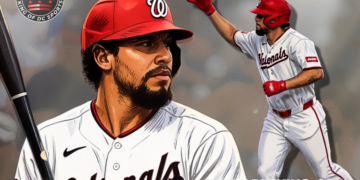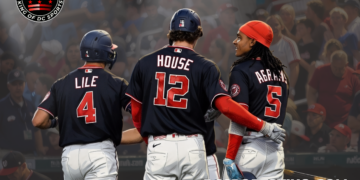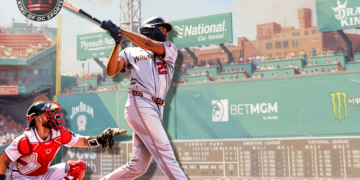





























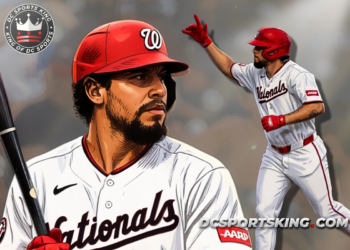










MLB’s August 3rd trade deadline always forces organizations to declare their timelines, and the latest one-for-one deal between the Washington Nationals and Boston Red Sox is a textbook example of two franchises operating with different strategic horizons.
In a bold, fascinating challenge trade, Washington has sent age-25 breakout corner infielder Curtis Mead to Boston in exchange for 24-year-old rookie left-handed starting pitcher Connelly Early.
It is a classic exchange of offensive surge for cost-controlled pitching upside. Here is a comprehensive look at the trade, the analytics behind the players, and what this blockbuster means for both organizations moving forward.
The Deal at a Glance
| Team | Player Acquired | Pos | Age | 2026 Key Stats | Contract / Control |
| Boston Red Sox | Curtis Mead | INF | 25 | .256/.351/.505, 17 HR, 48 RBI (136 OPS+) | Pre-Arbitration / Long-term control |
| Washington Nationals | Connelly Early | LHP | 24 | 3.44 ERA, 9.1 K/9 across 17 starts | Rookie / Long-term control |
What the Boston Red Sox Are Getting: A Legitimate Right-Handed Impact Bat
For Boston, acquiring Curtis Mead is an aggressive push to inject reliable right-handed power into a lineup fighting through the grinding stretch of a postseason race.
The Player Profile
Mead is in the midst of a genuine career renaissance in 2026. Through 86 games, the Australian-born infielder has blossomed into a potent offensive threat, slugging .505 with an .856 OPS and 17 home runs. His 136 OPS+ indicates he has performed a staggering 36% above the major league average this season.
Unlike many power hitters who sell out for home runs, Mead brings disciplined plate mechanics to the batter’s box. He boasts a sharp .351 on-base percentage, works counts effectively, and punishes mistakes elevated in the zone.
What It Means for Boston
- Fenway Park Tailor-Made: Mead’s right-handed pull-side and gap-to-gap power play exceptionally well with the dimensions of Fenway Park and the Green Monster.
- Lineup & Defensive Flexibility: While he has logged the bulk of his innings at third base this season, Mead is versatile enough to slide over to first base or second base, or slot in as a permanent middle-of-the-order Designated Hitter. He provides immediate insurance and everyday thrum for a Boston club looking to secure October baseball without sacrificing multi-year team control.
What the Washington Nationals Are Getting: A High-Upside Rotation Building Block
In exchange for parting with a breakout middle-of-the-order bat, Washington lands one of the most intriguing young left-handed arms to debut this season.
The Player Profile
Connelly Early has been a revelation across his first 17 big-league starts in 2026. The 24-year-old southpaw has pitched to a sparkling 3.44 ERA while generating strikeouts at an impressive 9.1 K/9 clip.
Early’s profile is defined by exceptional pitch design and command:
- The Arsenal: He attacks hitters with a deceptive, rising fastball that plays faster than its velocity, paired with a sweeping, swing-and-miss slider that has proven lethal against both lefties and righties. He also mixes in a fading changeup to neutralize right-handed heavy lineups.
- The Injury Note: Early was recently sidelined on the injured list with elbow inflammation. However, the Washington medical staff and front office clearly view this as a minor speed bump rather than a long-term deterrent, betting on his elite underlying metrics and clean mechanics.
What It Means for Washington
- Selling High to Build the Rotation: Washington’s front office recognized an opportunity to turn a position-player surplus into premium starting pitching. While the Nationals will miss Mead’s offensive production, getting an elite left-handed starting pitcher with six years of team control is arguably the hardest asset to acquire in modern baseball.
- A Corner-Infield Surplus Solved: Washington’s organizational depth in the infield allowed decision-makers to make this move from a position of strength, clearing an everyday pathway for emerging organizational talent while strengthening the pitching staff.
- The 2027 Timeline and Beyond: Adding a 24-year-old left-hander who has already proven he can get big-league hitters out gives Washington a strong foundational arm. Once healthy, Early is positioned to anchor the front end of Washington’s rotation alongside their developing core of young arms for years to come.
The Verdict: A Rare Win-Win Challenge Trade
In an era where trades commonly feature veterans being swapped for unproven teenagers in Single-A, a one-for-one challenge trade involving two 25-and-under big leaguer performers is a rare sight.
For the Red Sox, it’s a critical move to seize the moment in 2026. Boston gets a plug-and-play offensive catalyst whose right-handed swing is built for Fenway Park.
Meanwhile, the trade for the Nationals represents a savvy, calculated re-allocation of resources by the Washington front office. Turning a breakout age-25 hitter into a controllable, strikeout-generating left-handed starting pitcher strengthens the spine of the organization where it matters most: on the mound.