






































As the college sports landscape grows increasingly dominated by the financial muscle of the Big Ten and the SEC, fans and analysts alike are searching for ways to restore competitive balance to the ecosystem. Enter a fascinating hypothetical concept from DC Sports King: a super-league engineered to give college football—and athletics as a whole—a legitimate, sustainable counterweight to the emerging “Power Two.” Anchored by the independence of Notre Dame and featuring a collection of college basketball’s most iconic bluebloods, this visionary thought experiment explores what a perfectly balanced, modern conference could look like.
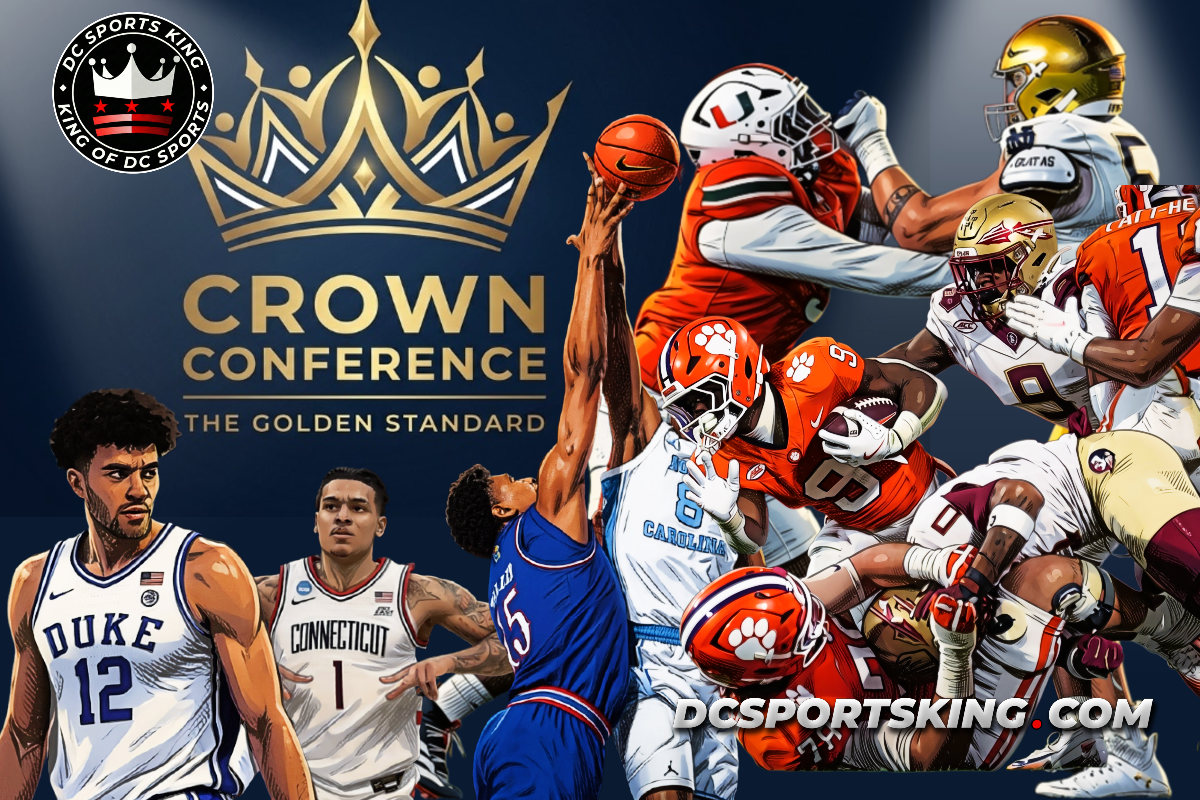
The 2031 college football season will mark the official launch of The Crown Collegiate Conference (CCC), an unprecedented 17-member athletic alliance engineered to challenge the financial dominance of the Big Ten and SEC.
Rather than expanding based solely on television market metrics, The Crown has been meticulously built around three foundational pillars: the inclusion of the University of Notre Dame, elite institutional research profiles, and an innovative, unbundled television media strategy. As legacy television contracts and grant-of-rights agreements expire at the end of the decade, The Crown represents the modern evolution of college sports—a coast-to-coast super-league designed to preserve tradition while fully funding the new era of direct athlete compensation.
The Notre Dame Anchor and the AAU Standard
For decades, the University of Notre Dame maintained its FBS football independence, prioritizing its exclusive national broadcast deal and academic standards. Securing Notre Dame’s membership required constructing a conference that mirrored those specific institutional priorities.
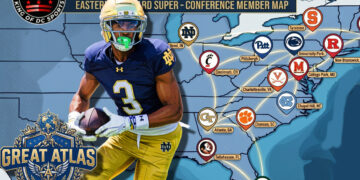
The Crown accomplishes this by assembling a roster heavy with Association of American Universities (AAU) members and top-tier academic flagships. The 16-team football membership includes:
- California, Clemson, Colorado, Duke, Florida State, Georgia Tech, Houston, Kansas, Miami, North Carolina, Notre Dame, Pittsburgh, Stanford, Syracuse, Virginia, and West Virginia.
- The University of Connecticut (UConn) joins as a 17th member to compete in basketball and Olympic sports.
By aligning Notre Dame with institutions like Stanford, Duke, Virginia, and North Carolina, the conference establishes a formidable academic consortium. This alignment proves that elite college athletics and premier higher education can successfully coexist within a modern collegiate model.
The Unbundled Media Revolution
The financial architecture of The Crown relies on unbundling football and basketball media rights to maximize open-market valuation. Instead of locking all inventory with a single broadcast partner, the conference divides its assets to dominate the sports calendar year-round.
The football package, valued at an estimated $1.2 billion annually, features a dual-network strategy. NBC retains its historic relationship with Notre Dame while gaining exclusive rights to “The Crown Game of the Week” in primetime. TNT Sports assumes the inventory volume, broadcasting Saturday doubleheaders and using Western members like Stanford and Colorado to anchor a lucrative “After Dark” late-night broadcast window.
Simultaneously, the league leverages a 17-team basketball roster featuring Duke, North Carolina, Kansas, and UConn to create a standalone basketball television contract worth roughly $300 million annually. The exclusive basketball package will be distributed across:
- CBS for weekend broadcast showcases.
- TNT for mid-week doubleheaders.
- Amazon Prime Video for an exclusive “Friday Night Hoops” streaming slate.
A 70/30 Financial Distribution Model
To sustain stability while rewarding the brands that drive television ratings, the conference will utilize a 70/30 hybrid revenue-sharing model.
Every member institution receives a 70% equal base share of the primary media rights. This baseline distribution guarantees that all athletic departments can fund the $22 million direct athlete revenue-sharing cap mandated by the House v. NCAA settlement, while also covering the logistical costs of cross-country travel.
The remaining 30% operates as a meritocracy. Television revenue is weighted by Nielsen viewership data, directly rewarding high-draw programs like Florida State, Clemson, and Notre Dame. Furthermore, postseason payouts—including College Football Playoff disbursements and NCAA Tournament basketball units—heavily favor the advancing teams rather than being strictly socialized across the league.
Protecting Olympic Sports Logistics
A coast-to-coast conference footprint demands innovative travel logistics. To protect non-revenue Olympic sports from the financial strain of constant transcontinental flights, The Crown utilizes strict regional pods. Eastern teams—such as Syracuse, Pittsburgh, West Virginia, and Virginia—will play most of their Olympic sports schedules within charter-bus distance.
For basketball, the league will implement a “2-for-1” travel model. When an East Coast program travels west to play California and Stanford, the team will play both universities over a single four-day window, cutting commercial flight expenses in half and minimizing missed class time.
Championship Tradition Redefined
The conference’s postseason formats are specifically designed to avoid television gridlock and maximize corporate sponsorship engagement.
- The Friday Night Football Championship: To avoid directly competing against the SEC and Big Ten championship broadcasts on Saturday, The Crown will play its football title game on Friday night in primetime on NBC. The game will rotate among premium neutral sites: the New RFK Stadium in Washington, D.C., Allegiant Stadium in Las Vegas, and SoFi Stadium in Los Angeles.
- The Chase for The Crown: The 17-team conference basketball tournament will be hosted at the Barclays Center in Brooklyn. The six-day event will utilize a tiered-bye format, granting the top four seeds a “triple-bye” to the quarterfinals. This structure protects highly rated teams from early-round fatigue, assuring that the sport’s biggest blue-bloods are primed for a Sunday championship broadcast on CBS.
When the inaugural season kicks off in 2031, The Crown Collegiate Conference will represent the pinnacle of modern college athletics. In this league, elite academics, historic rivalries, and unmatched media value converge.
Do you think a 70/30 hybrid revenue-sharing model like this would be enough to entice Notre Dame to finally give up its football independence?