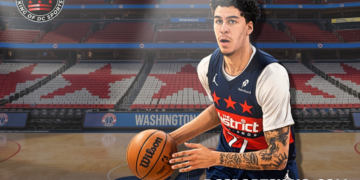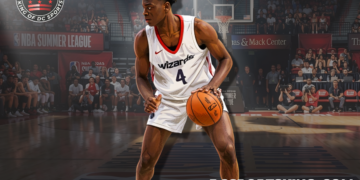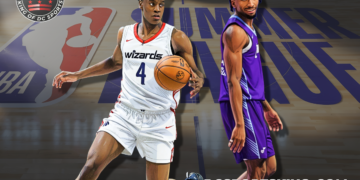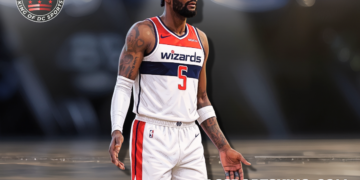










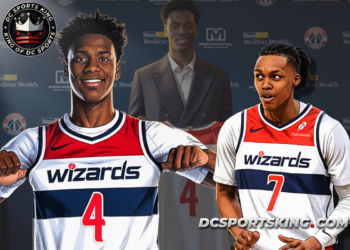




















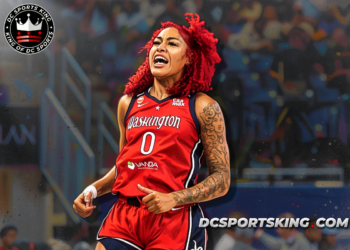

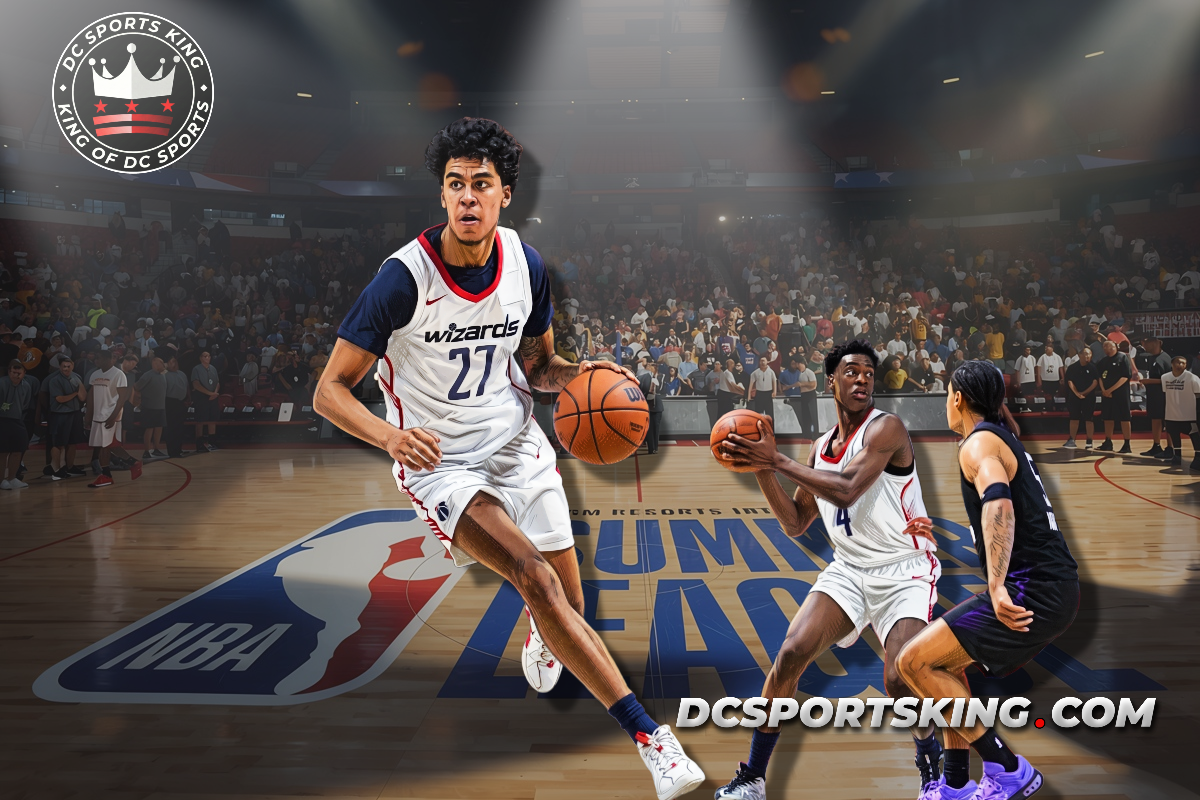
All eyes inside the Thomas & Mack Center on Sunday were glued to the marquee rookie attraction: Washington’s No. 1 overall pick AJ Dybantsa going head-to-head with Sacramento’s Darius Acuff Jr. The national media set the stage for a first-year clash, but by the final buzzer, it was second-year forward Will Riley who completely hijacked the headline.
In a dominant 104-85 blowout win over the Kings, Riley didn’t just quietly produce as a sophomore veteran—he put on an absolute offensive clinic, dropping a game-high 32 points and letting everyone know in Las Vegas why he is a key pillar of Washington’s future.
Will Riley Displayed Elite Efficiency
Summer League basketball is notorious for chaotic spacing, forced shots, and clunky isolation ball. What made Riley’s Sunday performance so breathtaking was the surgical efficiency with which he dismantled the Sacramento defense.
Playing just 29 minutes, the 6-foot-9 Canadian forward scored his 32 points within the natural flow of the offense:
- Shooting: 9-of-14 from the field (64.3%)
- Three-Point Range: 6-of-8 from beyond the arc (75.0%)
- Free Throw Line: 5-of-6 (83.3%)
- All-Around Board: 6 rebounds and 3 assists
While opposing defenders were swarming the driving lanes to collapse on Dybantsa, Riley punished every single rotation. Whether it was stepping into transition threes, attacking closeouts with a fluid first step, or pulling up from the mid-range when the shot clock dwindled, his shot selection was flawless. He didn’t just catch fire; he dictated the floor’s geography.
The Sophomore Leap is Officially Here
For anyone who watched the final stretch of Washington’s regular season last April, Sunday’s explosion didn’t come out of nowhere. Riley ended his rookie campaign by becoming the first Wizards rookie since Calbert Cheaney in 1994 to log back-to-back 30-point games. What we are seeing in July is the natural evolution of that late-season confidence.
Through two games in Las Vegas—following an 18-point outing in the 92-88 opening win over Utah—Riley is now averaging 25.0 points, 4.5 rebounds, and 2.5 assists.
The biggest difference between Year 1 and Year 2 is the game slowing down for him. His footwork is crisper, his release point from deep looks effortless, and he is using his 180-pound frame with much more physicality on the glass and on defensive switches. He isn’t rushing his offense; he’s letting the game come to him and punishing mismatches with the poise of a multi-year veteran.
A Glimpse of the Wing Rotation of the Future
Perhaps the most exciting takeaway for Washington’s long-term rebuild was the perfect rapport between Riley and Dybantsa. Rather than getting in each other’s way, the duo combined for 55 points and 13 rebounds to completely overwhelm Sacramento.
With Dybantsa drawing primary defensive assignments and slashing to the rim for 23 points and 7 boards, Riley acted as the ultimate release valve and primary perimeter punisher. Add Tre Johnson and Jamir Watkins into that backcourt and wing mix, and Washington is suddenly assembling an athletic, lengthy, and versatile young core capable of hurting defenses from all three levels.
Sunday was supposed to be a referendum on the 2026 draft class. Instead, Will Riley sent a loud message to the rest of the league: Washington’s rebuild isn’t just about the new arrivals—the pieces already in the building are ready to take over.