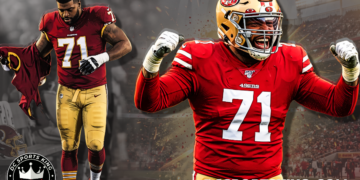







































When Deebo Samuel’s contract was officially voided this past February, many expected the Washington Commanders to at least make a courtesy push to keep the star playmaker in town. Instead, General Manager Adam Peters and the front office have been surprisingly quiet, largely standing pat while Samuel tests the free-agent waters.
While letting a big-name talent walk is never an easy pill for a fanbase to swallow, the reality is that bringing him back just doesn’t fit with Washington’s current roster-building strategy.
Here is a breakdown of why the front office seems content to let him walk:
1. The Void-Year Cap Mechanics
When the Commanders initially traded for Samuel last year, his restructured contract included void years designed to keep his 2025 cap hit manageable (under $6 million). However, when that contract naturally voided in February, it accelerated the remaining bonus money, instantly locking in a $12.34 million dead cap charge on Washington’s 2026 books.
Re-signing him wouldn’t magically erase that dead cap—it would just stack his new salary on top of it. With Samuel currently projected to seek around $15 million to $16 million annually in free agency, paying him that premium plus absorbing the dead money is the exact opposite of efficient roster building.
2. The Compensatory Pick Game
If Samuel signs a lucrative deal with another team—like the heavily rumored Chiefs or Bengals—the Commanders stand to benefit from the NFL’s compensatory pick formula.
A contract in the $15 million range could potentially net Washington an extra fourth-round pick in the 2027 NFL Draft, provided Peters doesn’t offset the formula by signing a similarly priced external free agent. For a front office actively trying to build sustainable, homegrown depth, acquiring a valuable mid-round pick simply by doing nothing is highly appealing.
3. Age and Offensive Trajectory
Samuel is now 30 years old. While his 2025 campaign with Washington was solid (72 catches, 727 yards, 5 TDs), the underlying metrics showed some decline. His yards-per-reception (10.1) and rushing efficiency (4.4 yards per carry) were both career lows. His entire game is built on bruising, physical play after the catch—a style that historically ages poorly for wide receivers.
Furthermore, with David Blough stepping in as the new offensive coordinator, the scheme is reportedly shifting toward generating more downfield explosive plays. The team likely prefers to invest its resources into younger, dynamic vertical threats who better fit Blough’s new blueprint, rather than a rugged, short-yardage specialist.
4. Low Sunk-Cost
It’s easy to fall into the “sunk-cost fallacy,” where teams overpay aging veterans just to justify a past trade. Fortunately, Peters only surrendered a 2025 fifth-round pick to the 49ers to acquire Samuel for a single season. Because the initial investment was so low, the front office isn’t under pressure to validate the move with a long-term extension.
Ultimately, Samuel provided the exact bridge production Washington needed last year. But extending a 30-year-old wideout at a premium price, eating dead cap, and ignoring the shift in offensive philosophy just doesn’t fit with the Commanders’ current rebuilding strategy.