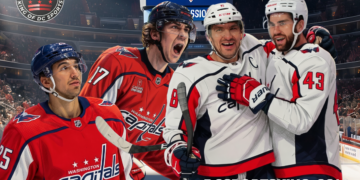





























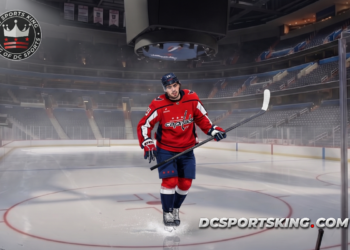





The Washington Capitals front office just sent a massive shockwave across the NHL ahead of draft weekend. By acquiring right winger Jordan Kyrou from the St. Louis Blues, senior vice president and GM Chris Patrick made an aggressive, definitive statement: Washington is retooling for high-end offensive playmaking right now.
To land a dynamic, prime-aged scoring engine, the Capitals had to part with significant foundational capital—most notably 25-year-old forward Connor McMichael. Here is the complete breakdown of the trade framework, the strategic anatomy behind McMichael’s exit, and what this signals for Washington’s overarching blueprint.
The Blockbuster Framework
The transaction represents a classic hockey blockbuster: an established, premier offensive driver exchanged for a package of immediate RFA potential, high-level European prospect pedigree, and premium draft capital.
| Washington Capitals Acquire | St. Louis Blues Acquire |
| Jordan Kyrou (RW, Age 28) | Connor McMichael (C/LW, Age 25) |
| Contract: 5 years remaining ($8.125M AAV) | Status: Restricted Free Agent (RFA) |
| Production: 378 career points in 488 GP | Milton Gästrin (C, 19yo prospect) |
| Accolades: 3x 30-goal scorer, 2022 All-Star | 2026 1st-Round Pick (16th overall) |
Anatomy of the Departure: Why Move McMichael?
For Capitals fans, saying goodbye to Connor McMichael (CMM) carries inevitable emotional weight. Selected 25th overall in 2019, McMichael successfully climbed the organizational ladder to establish himself as an authentic NHL regular. He enjoyed an exceptional breakout during the 2024-25 campaign, logging regular-season career highs with 26 goals and 57 points across all 82 games.
So, how did the front office arrive at his departure just one season later? It comes down to asset management, contractual timing, and analytical ceiling:
- Contractual Crossroads: McMichael just completed a two-year bridge deal carrying a $2.1 million annual cap hit. As a restricted free agent requiring a substantial pay raise and long-term commitment, the front office had to decide whether to lock up McMichael based on his peak developmental ceiling or leverage his prime market value to categorically upgrade the position.
- Production Context & Linemate Dependency: While McMichael posted a solid 14 goals and 46 points in 78 games during the 2025-26 season, underlying tracking data revealed a clear limitation: he became heavily reliant on his linemates to generate and finish high-danger opportunities. He generated a high volume of rush chances and breakaways, but struggled to consistently put the puck in the net without elite play-drivers doing the heavy lifting around him.
- Consolidating Assets for a Game-Breaker: Chris Patrick recognized that a package consisting of McMichael, a physical, two-way Swedish center prospect in Gästrin (37th overall in 2025), and the 16th overall pick was the mandatory cost of doing business to pry a premier talent out of St. Louis. Rather than hoping McMichael could replicate a 30-goal pace, Washington traded for a winger who has already hit that milestone three separate times.
Key insight: Both players finished the 2025-26 campaign with exactly 46 points, but Kyrou achieved his total in six fewer games while experiencing an uncharacteristically down finishing season. In the four seasons where Kyrou averaged over 16 minutes of ice time per night, his production exploded to an average of 32 goals and 71 points.
What This Means for Washington’s Ceiling
This blockbuster fundamentally elevates the Capitals’ offensive ceiling and sets the stage for the remainder of their summer strategy.
1. Elite Rush Injection for Spencer Carbery
Kyrou’s defining physical attributes are his world-class hands, top-end speed, and dual-threat skill off the rush. Washington’s offense frequently bogged down during 5-on-5 play last season; Kyrou acts as a pure human spark plug who can single-handedly transition the puck through the neutral zone and back down the opposition’s defense.
2. Built-in Sarnia Sting Chemistry
Kyrou won’t be walking into a completely unfamiliar locker room. He reunites with Capitals defenseman Jakob Chychrun—his former junior hockey teammate with the OHL’s Sarnia Sting. That existing chemistry should help accelerate Kyrou’s inclusion in Washington’s top-six deployment.
3. Untouched Cap Flexibility
Perhaps the absolute masterclass element of this trade is what Washington kept. Even after absorbing Kyrou’s $8.125 million AAV through the 2030-31 season, the Capitals still hold just over $23.2 million in salary cap space. Furthermore, Washington still owns the 18th overall selection in the 2026 Draft (acquired from the Anaheim Ducks). Chris Patrick successfully acquired a prime-aged, elite-scoring engine without draining his financial war chest in free agency.