





































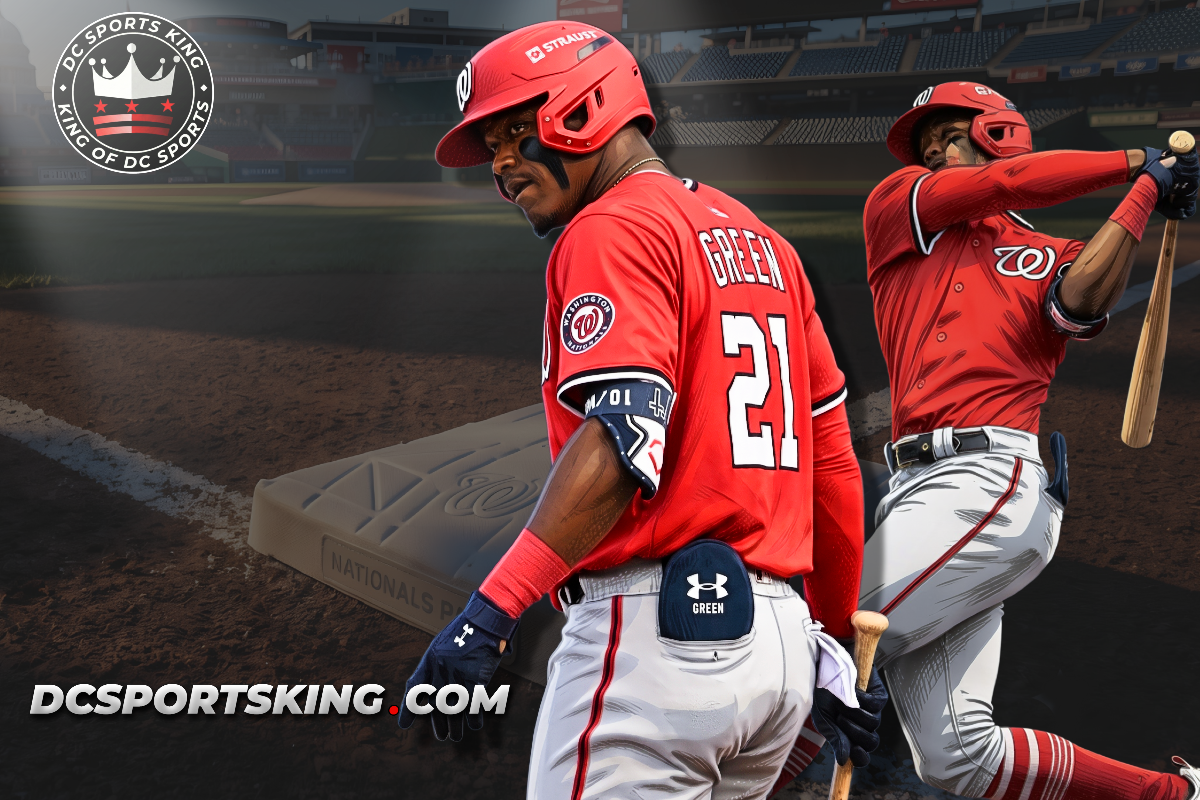
When the Washington Nationals selected IMG Academy outfielder Elijah Green with the fifth overall pick in the 2022 MLB Draft and handed him a $6.5 million signing bonus, the consensus was unanimous: Washington had just drafted a generational athlete. With a 6-foot-3, 225-pound frame that resembled an NFL linebacker—a fitting physical inheritance from his father, two-time NFL Pro Bowl tight end Eric Green—Elijah possessed a tantalizing combination of 70-grade raw power and 70-grade elite speed.
Fast forward to the summer of 2026, and the landscape around Green has dramatically shifted. Once ranked as high as the No. 3 prospect in Washington’s farm system and a top-50 prospect in all of baseball, Green has completely fallen off major Top-30 prospect rankings. Instead of knocking on the door of Nationals Park, the 22-year-old is grinding through the South Atlantic League, battling the exact same demons that have plagued him since day one.
Where is Elijah Green Playing Now?
Green is currently stationed with the Wilmington Blue Rocks, the High-A affiliate of the Washington Nationals. He was assigned to Wilmington to open the 2026 campaign after a 2025 season that was largely derailed by a persistent hamstring injury, forcing him to spend significant time rehabbing across the Florida Complex League and Single-A Fredericksburg before getting a brief 35-game taste of High-A.
Now healthy and playing almost daily in Wilmington’s outfield, Green’s 2026 season illustrates the maddening contrast of his career: loud, game-changing athletic highlights overshadowed by a staggering inability to put the ball in play.
2026 High-A Season Snapshot (through mid-July)
| Stat Category | 2026 Output | What It Means |
| Games Played | 78 | Healthy and getting consistent everyday reps. |
| Slash Line | .211 / .310 / .361 | Marginal improvement over 2025, but still far below league average. |
| Power Output | 10 HR, 11 2B, 31 RBI | The raw strength remains intact when he makes contact. |
| Speed & Baserunning | 27 SB (4 CS) | Still an elite base-stealer with high-end sprint speeds. |
| Plate Discipline | 148 SO / 41 BB | A strikeout rate hovering near 46%, the primary anchor on his stock. |
Why He Fell Out of the Top 30
To understand why prospect evaluators have hit the pause button on Green’s major league projection, you have to look beyond the physical build and examine the underlying swing mechanics and plate approaches.
1. Historic, Unrelenting Strikeout Rates
In modern baseball, front offices are more tolerant of strikeouts than ever before—provided they come with walks and serious damage output. However, Green’s swing-and-miss numbers have crossed from “concerning” into historic territory. Across his five-season minor league career, Green has racked up over 650 strikeouts in just 360 games.
Whether at Single-A Fredericksburg (where he struck out 206 times in 106 games in 2024) or High-A Wilmington, his strikeout rate has consistently sat between 40% and 46%. For context, even the most strikeout-prone power hitters in the major leagues rarely exceed a 33% strikeout rate. A player simply cannot survive against upper-level minor league pitching—let alone major league pitching—whiffing in nearly half of his plate appearances.
2. The 30-Grade Hit Tool and Pitch Recognition
Scouts evaluate players on the 20-to-80 scale, where 50 represents major league average. Today, evaluators consistently slap a 30 grade on Green’s hit tool—a harsh mark that denotes severe contact deficiencies.
When Green connects, the ball explodes off his bat with elite exit velocities. But getting to that power requires navigating breaking balls and elevated velocity. Advanced scouting reports note that Green routinely struggles with pitch recognition out of the pitcher’s hand, frequently committing early on sliders in the dirt or swinging through fastballs at the top of the zone. Until he tightens his swing decisions, upper-level pitchers will continue to exploit these holes without ever throwing him a strike.
3. Stagnant Production in the Low Minors
Because the strikeouts create an artificial ceiling on his offensive production, his batting averages have remained stagnant across three years in the lower minors. He hit .210 in 2023, followed by .208 in 2024, and is hitting just .211 in High-A in 2026. Without the ability to string together consistent contact, he hasn’t been able to force the organization’s hand for a promotion to Double-A Harrisburg.
The Untapped Ceiling Still Exists
Despite the steep drop in the rankings, it would be foolish to completely write off Elijah Green. Player development is rarely linear, and tools as loud as his do not grow on trees.
When you watch Green in center field, he still looks every bit the part of a future superstar. His instincts, arm strength, and closing speed make him an above-average defensive center fielder right now. On the basepaths, his 27 stolen bases in 2026 prove that once he actually reaches first base, he is a dynamic, disruptive force.
The Nationals’ player development staff faces one of the most intriguing reclamation projects in recent draft history. If Green can make even a modest mechanical adjustment—shortening his leg kick, flattening his bat path, or adopting a more passive approach early in counts to cut his strikeout rate down to the 30–33% range—his elite raw tools could rapidly propel him right back onto top-prospect boards. But until that contact breakthrough occurs, he remains the ultimate baseball paradox: a million-dollar athlete trapped in a ten-cent swing.